Part 05 · Valuing injury to feelings
Injury to feelings: a viewer for 2,510 published awards
Every injury to feelings award in the published judgments, searchable by band, protected characteristic and claim year, with a proposed figure placed among the awards tribunals have made.
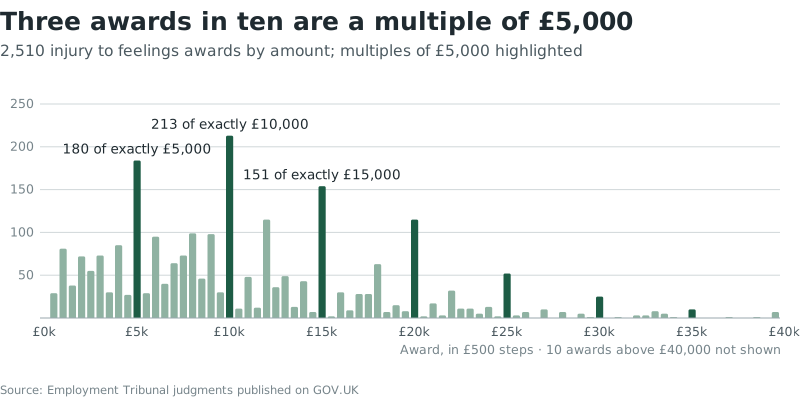
Valuing injury to feelings usually means placing a claim within the Vento bands and then looking for comparable awards, whether from a curated table of selected cases or from experience. The injury to feelings awards viewer approaches it from the published decisions themselves: 2,510 awards for injury to feelings, extracted from Employment Tribunal judgments on GOV.UK, each linked to its judgment, and updated as new decisions are added.
Where the awards come from
The awards were found in two passes over the 134,000 judgments described earlier in the series. A pattern-matching pass identified every judgment that mentions injury to feelings: 5,342. A language model running on my own computer then read each of those and decided whether the tribunal had made an award, as opposed to quoting a band, a schedule of loss or an award in another case. Each figure it reported was checked against the text of the judgment. Where the figure could not be found verbatim, or the model’s reading was doubtful, the award was set aside rather than included. When this article was written, 2,510 awards had passed these checks. The process, and where it went wrong, is described in Building the awards database. (Coming soon)
The viewer
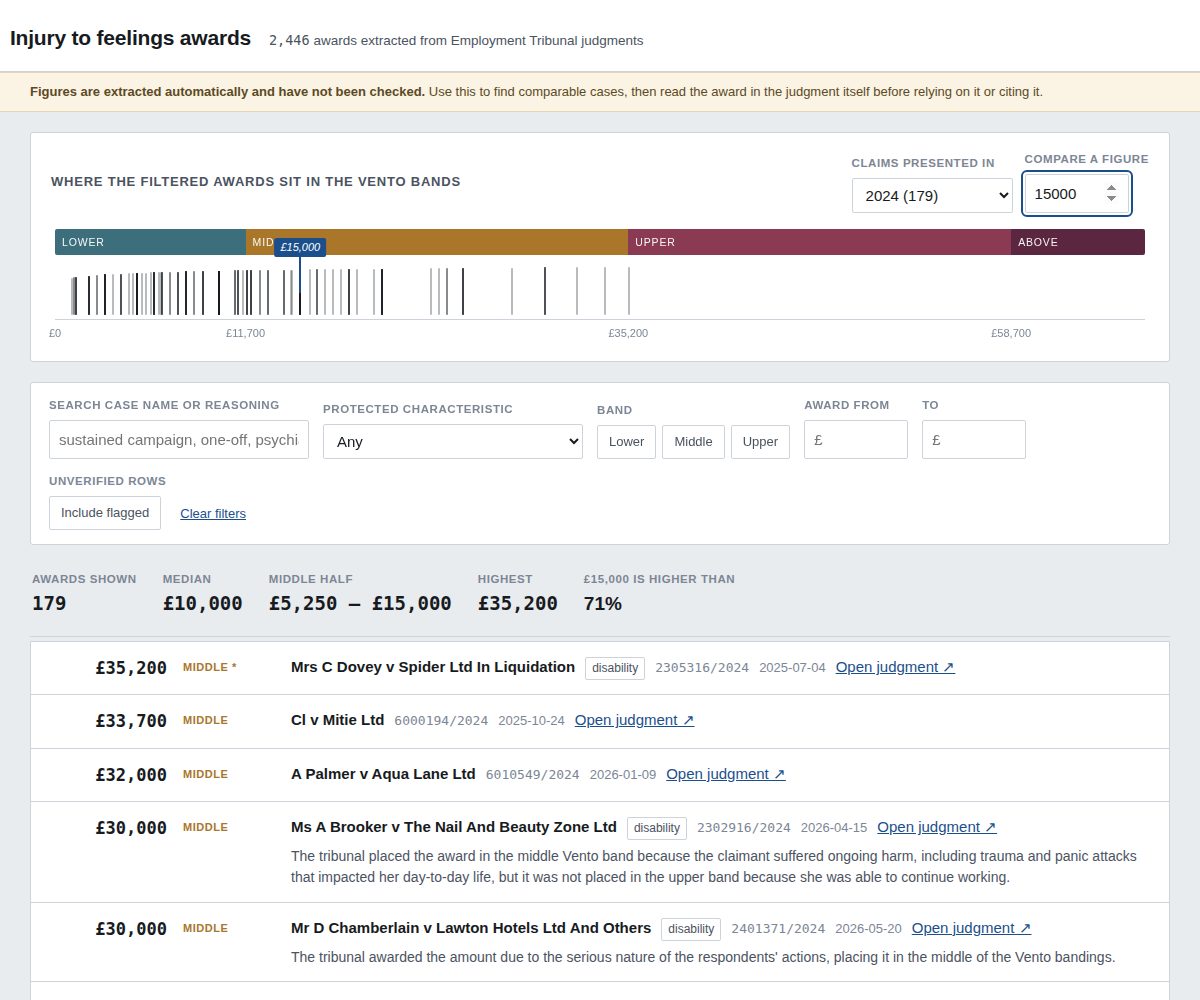
The viewer, filtered to claims presented in 2024.
The page is a single file with the awards embedded in it, and works on a phone.
The band ruler. The main element is a horizontal ruler showing the Vento bands, with each matching award drawn as a mark. Because the bands depend on when the claim was presented, the ruler works by claim year, taken from the case number: selecting claims presented in 2024 shows the 2024 awards against the 2024 bands. Claims presented before 2017 are grouped together, since they share the original bands.
Comparing a figure. A figure entered in the comparison box appears as a marker on the ruler, with the proportion of the filtered awards it exceeds. It is a quick check on a proposed valuation, for a practitioner or for a claimant preparing a schedule of loss without representation.
Filters. Awards can be narrowed by protected characteristic, band and amount, and by a search across case names and the tribunal’s reasons. Searching for “sustained campaign”, “one-off” or “no medical evidence” finds cases on recognisably similar facts.
Each award shows the amount, the band, the case name and number, the date, a link to the judgment on GOV.UK and, where the judgment gives one, a sentence on the factors that set the level: how long the conduct lasted, how serious its effect was, whether there was medical evidence, and whether there were aggravating features.
What the awards show
Some features of the full set are visible at once. Later articles examine each in more detail. The figures below were taken when this article was written; the viewer shows its own count and the date it was last updated.
- The median award is £10,000, and half of all awards fall between £5,000 and £15,000.
- Awards are divided almost equally between the lower and middle bands. Only 92 are in or above the upper band.
- Disability is the basis of 906 awards, more than a third of the total. Sex (395), pregnancy and maternity (357), whistleblowing (347) and race (296) follow. An award made on more than one ground is counted under each.
Limitations
Every figure in the viewer was extracted automatically, and the page says so before it shows any number. Two labels identify rows to treat with care. Review marks an award that failed one of the automated checks. Band check marks one where the tribunal named a band that does not match the recorded figure, which usually means that the amount or the claim year is wrong. Flagged rows are hidden by default and can be shown.
The viewer follows the approach to data protection set out earlier in the series. It keeps case names, because that is how decisions are identified, but it is excluded from search engines, its reasons are confined to the legal factors rather than the detail of anyone’s health or circumstances, and a judgment removed or anonymised on GOV.UK is removed or anonymised in the viewer at the next update.
The viewer is at et-workbench-blog.pages.dev/awards.
Doing this yourself
- The output is simpler than the pipeline. The viewer is one HTML file with the data embedded as a table and a few hundred lines of script for the ruler and filters. It can be hosted anywhere that serves static files.
- Work by claim year, not judgment date. The band that applies depends on when the claim was presented, and the case number gives that reliably.
- Keep the link to the source on every row. It is what allows a reader to check a figure, and it is what makes an automated dataset usable in practice.
- Hide doubtful rows by default, but keep them. Rows that fail a check are still informative, and showing them separately is more honest than removing them.
Next: finding awards made on comparable facts.